Enterprise Security Infrastructure for Small Business

June 16, 2026 · Security & Access Control
Enterprise Security Infrastructure for Small Business

43% of cyberattacks target small businesses. Enterprise-level protection is no longer optional β€” and with the right open-source stack, it's no longer out of reach.

⬇ Download the full presentation (PDF) 7-Layer Enterprise Security Infrastructure β€” MKR Systems Get PDF β†’

7 Solution Layers. One Integrated Infrastructure.

Most small business IT setups are a collection of disconnected tools β€” a firewall here, a cloud service there, backups that may or may not work. MKR builds infrastructure where every layer is designed to work with every other layer: security policies flow from identity management, backups integrate with virtualization, and remote access ties into your internal firewall zones.

Layer 01
Cloudflare Tunnel + Double Caddy
Secure external access with zero open ports. DDoS protection at the edge before traffic reaches your network.
Layer 02
UDM Pro + Firewall + VPN
Zone-based network segmentation and encrypted remote access with per-user policy enforcement.
Layer 03
Proxmox + PBS + DRBD
Enterprise virtualization with real-time server replication, quorum-based failover, and ransomware-resistant backups.
Layer 04
FreeIPA + Keycloak SSO
One account for every service. One action to block a compromised credential or a departing employee.
Layer 05
NAS: FreeIPA + Samba
Permission-based network storage accessible only from authenticated devices. Quorum-based failover with DRBD.
Layer 06
Cloud Workspace
Nextcloud, OpenProject, Vaultwarden, Outline β€” a complete self-hosted work platform behind SSO and VPN.
Layer 07
Cyber Security Architecture
7 chained defense layers from the public internet to internal apps, with central audit logging.
Layer 01
Cloudflare Tunnel + Double Caddy
Secure external access Β· No open ports required

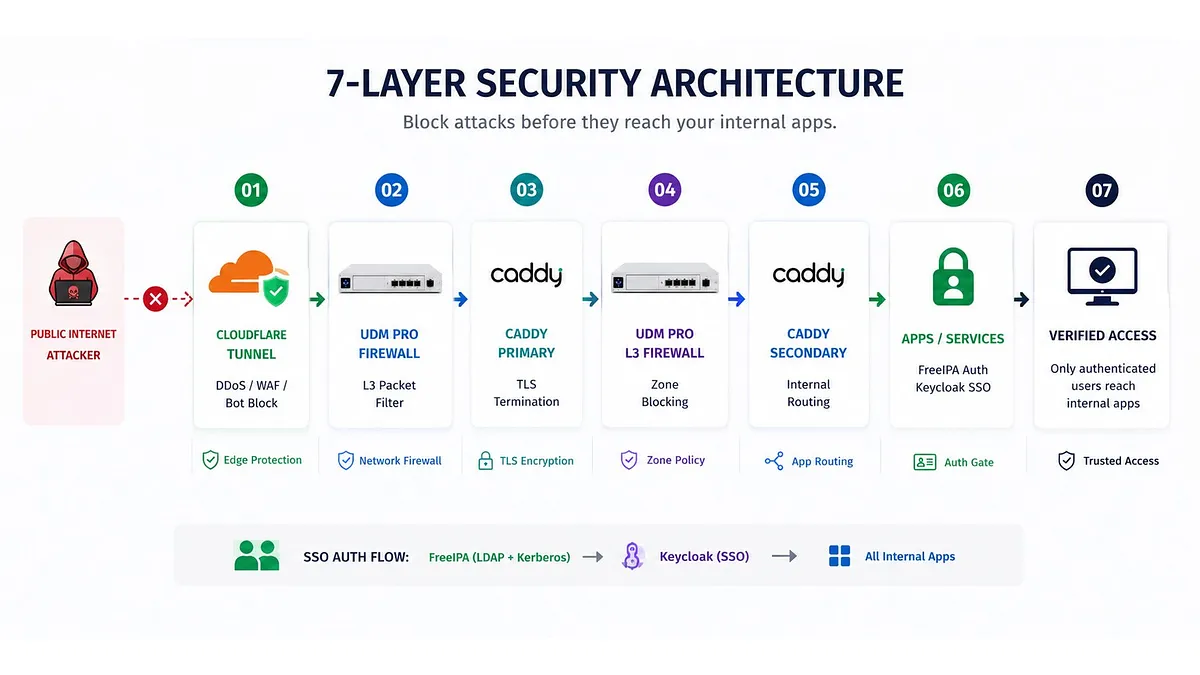
Most businesses expose services to the internet by opening firewall ports β€” creating attack surfaces that scanners find within minutes. Cloudflare Tunnel reverses this: your server initiates an outbound-only encrypted connection to Cloudflare's network, so there are no inbound ports to probe. DDoS mitigation and WAF filtering happen at Cloudflare's edge (330+ cities across 120+ countries) before traffic ever touches your infrastructure.

The Double Caddy architecture adds a second layer of protection: a primary reverse proxy handles TLS termination and blocks external attack traffic, while a secondary proxy handles internal app routing and access control. An attacker who bypasses Cloudflare's edge still hits two proxy layers before reaching any application.

No open ports β€” nothing on your firewall is exposed to the public internet
Works without a static IP address β€” Cloudflare handles DNS and routing
End-to-end TLS encryption from browser to application
Free plan DDoS protection, WAF, and bot management at the Cloudflare edge
Zero Trust model: every external connection is treated as untrusted until verified
Layer 02
UDM Pro + Zone-Based Firewall + VPN
Network segmentation Β· Encrypted remote access

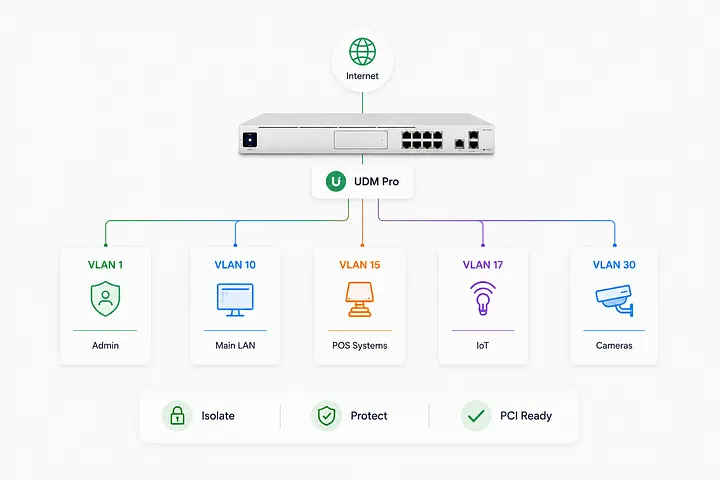
A flat network β€” where every device can reach every other device β€” is a security disaster waiting to happen. MKR configures zone-based firewall rules on the UniFi Dream Machine Pro: WAN, DMZ (public services), LAN (internal), and IoT each exist in their own security zone with explicit policies controlling what can communicate across boundaries.

Network divided into security zones β€” a compromised IoT device cannot reach your file server
VPN access requires FreeIPA authentication β€” credentials, not just a VPN key
Per-user VPN policies limit which zones remote workers can access
New devices automatically inherit zone policies when connected
Real-time connection monitoring and full access history logs
Layer 03
Proxmox + Proxmox Backup Server + DRBD
Virtualization Β· Auto-recovery Β· Ransomware-protected backups

Proxmox is enterprise-grade hypervisor software that runs multiple isolated virtual machines and containers on a single physical server (or clustered across several). MKR layers three redundancy systems on top: ZFS for automatic disk-level recovery inside a server, DRBD for real-time replication across servers, and Proxmox Backup Server for deduplicated, ransomware-resistant backups.

ZFS: automatic disk mirroring and data integrity verification β€” no traditional RAID needed
DRBD: 2 diskful nodes + 1 diskless quorum node, real-time replication, automatic failover via DRBD Reactor/Pacemaker (brief I/O pause; DRBD/LINSTOR maintained & supported by LINBIT, not bundled with Proxmox)
Proxmox Backup Server: deduplication + compression typically cuts backup storage 5–10Γ— (workload-dependent), snapshot-based with minimal performance impact
Ransomware-resistant backups: protected by role separation, off-site sync, and optional S3 Object Lock immutability (PBS has no native WORM flag)
Multiple backups per day with fast, SHA-256–verified restore capability
Layer 04
FreeIPA + Keycloak β€” Integrated Identity & SSO
One account Β· All services Β· Centralized control

When every service has its own login, security falls apart fast β€” people reuse passwords, share credentials, and leaving employees retain access for months. FreeIPA (built on Red Hat Enterprise Linux technology) provides centralized LDAP directory, Kerberos authentication, DNS, and a Certificate Authority. Keycloak connects it all to web applications via OIDC, SAML, and OAuth 2.0.

One account, one password for every service across the organization
Compromised password: one action blocks access to all connected services immediately
Employee offboarding: one account disable, all access revoked across all systems
MFA (multi-factor authentication) enforced for any or all services via Keycloak
Role-based access control (RBAC) β€” different teams see different services
Central security audit log: who accessed what, when, from where
Layer 05
NAS: FreeIPA + Samba β€” Permission-Based Storage
Authenticated access only Β· High availability

Network storage that anyone on the network can access is not storage β€” it is a liability. MKR configures Samba as a domain member of FreeIPA, so only computers and users that have authenticated against the directory can access NAS shares. Unverified devices are blocked at the authentication layer, not just at the firewall.

Only FreeIPA-authenticated PCs and Macs can access any file share
Granular file permissions by user, group, and share β€” each team sees only what they need
Full Windows, macOS, and Linux compatibility via Samba
Built on DRBD: if one storage server fails, the standby resumes service within sub-minute (quorum-managed via DRBD Reactor/Pacemaker)
ZFS checksums verify every read β€” silent data corruption is caught and corrected
Layer 06
Cloud Workspace β€” Nextcloud, OpenProject, Vaultwarden & More
Self-hosted Β· SSO-integrated Β· VPN-secured

Instead of paying SaaS subscriptions for every tool β€” and trusting third-party servers with your business data β€” MKR builds a self-hosted workspace where every application integrates with Keycloak SSO and is accessible only through VPN. Your data stays on your infrastructure, under your control.

Nextcloud: unlimited shared storage, group chat, video meeting recording
OpenProject: project schedule management, Kanban, Gantt charts, file sharing
Vaultwarden: self-hosted password manager (Bitwarden-compatible) β€” generates and stores a unique strong password per app, so nothing is reused or memorized
Paperless: document digitization, OCR, automatic classification, searchable archive
Outline: team knowledge base and wiki with collaborative documentation
All apps: single login via Keycloak SSO, all data behind VPN

7-Layer Defense: From Public Internet to Internal Apps

PUBLIC INTERNET ↓ ATTACKER Cloudflare DDoS/WAF Block UDM Pro L3 Packet Filter Caddy Primary TLS Termination UDM Pro L3 Firewall Zone Block Caddy Secondary Int. Routing Apps FreeIPA Auth Keycloak SSO βœ“ VERIFIED βœ— Edge CDN WANβ†’LAN TLS + Block Zone Policy App Route Auth Gate SSO AUTH FLOW: FreeIPA (LDAP + Kerberos) β†’ Keycloak β†’ All Apps BLOCKED AT EDGE
MKR Technology Solutions β€” 7-Layer Security Architecture

Zero Trust–Aligned Architecture β€” The Underlying Principle

Zero Trust is not a product β€” it is a design principle. Every access request, from every user and device, on every network (including your own internal LAN), is treated as untrusted until verified. MKR's 7-layer stack applies Zero Trust principles β€” identity-verified access at every layer through FreeIPA, Keycloak SSO, and Cloudflare Access β€” rather than trusting the network perimeter. (Full per-request enforcement to NIST SP 800-207 is achieved by placing Cloudflare Access in front of every internal app.)

πŸ”
Zero Trust Access
Every access request requires authentication β€” even inside the internal network. No implicit trust based on network location.
πŸ”‘
Password Exposure Prevention
Vaultwarden generates and stores a unique strong password for every application, so credentials are never reused β€” and MFA protects every login. Length over complexity, per NIST SP 800-63B.
πŸ›‘οΈ
VPN-Based Data Access
All remote access to internal data travels through an encrypted VPN tunnel. No data is reachable from the open internet.
πŸ’Ύ
Automatic Backup & Recovery
PBS ransomware-resistant backups plus DRBD quorum-based failover. Business continuity with minimal manual intervention.
πŸ€–
Attack Pattern Defense
Cloudflare bot management and WAF rulesets filter attack patterns at the edge before they reach your infrastructure.
πŸ“‹
Central Audit Logging
All authentication events, access attempts, and system actions are logged centrally for security review and compliance.

What Business Owners Ask About Enterprise Security

What is Zero Trust and does my small business actually need it?

Zero Trust means no user, device, or connection is automatically trusted β€” even inside your own network. Every access request must be verified. Small businesses need this because 43% of cyberattacks target small companies, and a single compromised credential can expose everything. MKR applies Zero Trust principles through Cloudflare Tunnel, FreeIPA, Keycloak SSO, and Cloudflare Access so every service requires identity verification before granting access.

What is a Cloudflare Tunnel and why is it safer than opening firewall ports?

A Cloudflare Tunnel creates an outbound-only encrypted connection from your server to Cloudflare's network, eliminating the need to open any inbound ports on your firewall. Attackers cannot scan for or probe what does not exist. DDoS protection and WAF filtering happen at Cloudflare's edge β€” across 330+ cities in 120+ countries β€” before any traffic reaches your infrastructure.

What is Proxmox and how does it protect against data loss?

Proxmox is an enterprise virtualization platform that runs multiple services on one physical server (or cluster). MKR combines it with ZFS for automatic disk recovery, DRBD for real-time server-to-server replication, and Proxmox Backup Server for deduplicated, ransomware-resistant backups. PBS deduplication and compression typically reduce backup storage 5–10Γ— (this is deduplication, not raw compression, and varies by workload). If a disk fails, ZFS recovers automatically. If a server fails, DRBD quorum-based failover (via DRBD Reactor or Pacemaker) restores service within sub-minute.

What is FreeIPA and Keycloak SSO, and why does a small team need it?

FreeIPA (built on Red Hat technology) is centralized identity management combining LDAP, Kerberos, DNS, and a Certificate Authority. Keycloak connects it to all web applications using OIDC, SAML, and OAuth 2.0. Together, one account accesses everything β€” and when an employee leaves, disabling one account immediately blocks access to every service. No more shared passwords, forgotten credential revocations, or orphaned accounts.

How is this different from just using Microsoft 365 or Google Workspace?

Microsoft 365 and Google Workspace are hosted on third-party servers and charge per-seat licensing fees. MKR's stack is self-hosted on your own infrastructure β€” your data stays under your control. The open-source tools (Proxmox, FreeIPA, Nextcloud, Cloudflare) eliminate per-seat fees and vendor lock-in. For teams handling sensitive data β€” healthcare, legal, financial, or any regulated industry β€” self-hosted is often a compliance necessity, not just a preference.

β˜… MKR Technology Solutions Β· Free Infrastructure Assessment β˜…

Ready to Build Infrastructure
That Actually Protects Your Business?

MKR analyzes your current setup and proposes the optimal configuration for your team size and budget.

No per-seat licensing. No vendor lock-in. Enterprise-grade security, sized for you.

888-382-5164

Free On-Site Assessment Β· MKR Technology Solutions Β· La Mesa, CA 91941

Los Angeles Β· Orange County Β· Riverside Β· San Diego Β· Southern California

⬇ Download the Full PDF Guide β†’ Free Infrastructure Assessment Learn More at makeonline.io β†’
References & Data Sources
  • [1]Cloudflare β€” Cloudflare Tunnel Documentation β€” Zero Trust access, outbound-only connections, DDoS protection, WAF, and bot management. developers.cloudflare.com
  • [2]Proxmox VE β€” Official Documentation, Proxmox Backup Server β€” Virtualization platform, ZFS storage, DRBD replication, and backup compression specifications. proxmox.com
  • [3]Red Hat β€” FreeIPA Identity Management β€” Centralized LDAP, Kerberos, DNS, and CA for Linux/Unix environments. freeipa.org
  • [4]Keycloak β€” Open Source Identity and Access Management β€” OIDC, SAML, OAuth 2.0 SSO broker with MFA and RBAC support. keycloak.org
  • [5]Verizon β€” 2024 Data Breach Investigations Report β€” 43% of cyberattacks target small businesses. Small businesses represent a disproportionate share of breach victims due to lower security investment. verizon.com

MKR Technology Solutions provides IT infrastructure design, deployment, and management for small businesses and enterprise teams in Southern California. This article describes a complete infrastructure buildout approach using open-source enterprise tools. Specific configurations vary based on organization size, compliance requirements, and existing infrastructure. Contact MKR at 888-382-5164 for a tailored assessment.

network security unifi proxmox caddy cloudflare cybersecurity

Tell Us About Your Property

Request a free quote and site survey for fiber, network, and structured cabling tailored to your building.

Request a Quote

Related Articles

Install makeonline.io for quick access